


Pakistan Minority Commission: The weight of symbolism

The passage of Pakistan’s National Commission for Minorities’ Rights Bill on December 3, 2025, by a joint sitting of Parliament, represents yet another instance of the state signalling reform while ensuring that no substantive alteration occurs in the legal and ideological structures underpinning systemic discrimination. Approved with 160 votes in favour against 79 opposed, the legislation was stripped of its most consequential provisions – suo motu powers and an overriding-effect clause – before its adoption, rendering the new body largely symbolic.
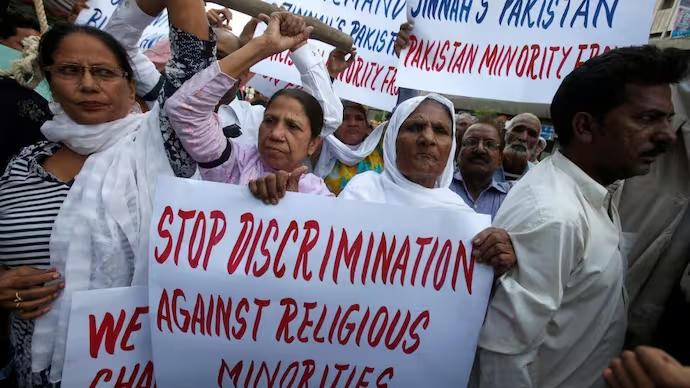
Law Minister Azam Nazeer Tarar presented the Bill as a long-awaited mechanism to institutionalise minority concerns, but the parliamentary negotiations that preceded its passage ensured that it does not, and cannot, challenge the entrenched framework of Islamisation that has governed Pakistan’s polity for decades. The newly established Commission thus enters a landscape shaped by persistent structural inequities, recurring episodes of mob violence, and a constitutional order that continues to define citizenship and rights through a strictly majoritarian lens.
Pakistan’s trajectory since independence has been defined by a progressive constriction of minority rights. Demographically, minorities constituted approximately 23 per cent of the population in the 1951 census (including East Pakistan) but today stand at roughly 3–4 per cent. Hindus and Christians each represent slightly under two per cent of the population, while Sikhs, Parsis, Bahais and Kalash communities form fractions of a percentage point. This dramatic contraction reflects decades of insecurity, discriminatory legislation, and routine societal violence that have produced steady out-migration, especially among Hindus and Christians.
The constitutional declaration of Ahmadis as non-Muslims in 1974 and the 1984 promulgation of Ordinance XX under General Zia-ul-Haq, which criminalised Ahmadi religious expression, legally codified an hierarchical citizenship structure that no government – civilian or military – has sought to reverse. These foundational measures remain central to Pakistan’s contemporary political identity and continue to dictate the parameters of permissible reform.
The data on prosecutions and associated violence provides stark evidence of the dangers confronting both Muslims and non-Muslims, though the latter remain disproportionately affected. According to the Centre for Social Justice (CSJ), at least 2,793 individuals had been accused of blasphemy between 1987 and 2024. In 2024 alone, 344 new blasphemy cases were reported, of which about 70 per cent of suspects were Muslims, followed by Ahmadis (14 per cent), Hindus (nine percent), and Christians (six per cent).
The National Commission for Human Rights (NCHR) reported a steep rise in blasphemy‐related incarcerations: 705 individuals in detention facing blasphemy trials as of late 2023; by mid-2024, there were 767 prisoners charged with blasphemy. Regarding extrajudicial killings, the CSJ recorded 104 deaths linked to blasphemy accusations between 1994 and 2024. In 2024 alone, ten individuals accused of blasphemy were killed by mobs or while in custody. Nine of those killed were Muslim; one was Christian.
Ahmadis remain particularly vulnerable; CSJ data for 2023 showed that they represented 20 per cent of all accused despite officially constituting 0.07 per cent of the population. The pattern of vigilantism, encouraged by clerical mobilisation and administrative complicity, ensures that even acquittals offer no safety, as mobs have frequently targeted those freed by courts.
Forced conversions also remain deeply concerning: between 2021 and 2024, 421 cases were reported, mostly involving minority girls (282 Hindu, 137 Christian, and 2 Sikh), with 71 per cent of them minors.
The situation for minority women and girls is particularly dire. Abductions followed by coerced marriages and forcible coercion, primarily affecting Christian and Hindu communities, constitute a persistent form of structural violence. Civil-society estimates – including submissions to United Nations (UN) mechanisms, analyses by Human Rights Commission of Pakistan (HRCP), and documentation by Aurat Foundation – suggest that around 1,000 Hindu and Christian girls are abducted, forcibly converted, and married off each year in Pakistan, with Sindh and south Punjab the primary hotspots.
Police routinely decline to register kidnapping complaints, lower courts accept coerced statements from minors, and clerics legitimise conversions without scrutiny. A joint National Commission for Human Rights (NCHR)–Legal Aid Society report documents that in several districts, not a single conviction has been recorded despite dozens of documented cases annually, underscoring the dysfunction of the criminal justice system in protecting minority women.
The economic and social marginalisation of minorities runs parallel to these legal vulnerabilities. Pakistan’s federal job quota reserves five per cent of government positions for non-Muslims, but data compiled by the National Commission for Justice and Peace indicates actual implementation rarely exceeds two per cent. Literacy disparities remain severe: the Pakistan Institute of Education’s 2022 survey recorded a literacy rate of only 28 per cent among Hindu women in rural Sindh, compared to a national average of 48 per cent.
Bonded labour, particularly in the brick-kiln sector of Sindh and southern Punjab, continues to trap hundreds of thousands – mostly Hindus and Christians – in cycles of debt-servitude, despite existing laws prohibiting such practices. These socio-economic inequities strengthen conditions of structural vulnerability and enable the recurrent targeting of minority communities by criminal, religious, and feudal networks.
Ahmadis remain uniquely exposed to both state persecution and vigilantism due to the formal criminalisation of their religious identity. UN Special Procedures noted in 2025 that the community faced “numerous violations” including killings, arbitrary arrests of minors and persons with disabilities, and systematic attacks on places of worship. The demolition of a century-old Ahmadi mosque in Daska, the sealing of multiple mosques in Karachi and Bahawalnagar, and the desecration of 82 graves in Kotli, Azad Jammu and Kashmir, exemplify the continuum of abuse.
Despite a June 2024 National Assembly resolution urging protective measures for all citizens, there has been no reduction in the frequency or severity of these incidents. Significantly, the new Commission explicitly excludes Ahmadis on the grounds that they reject their legally mandated non-Muslim status, thereby entrenching their exclusion from even the limited protections purportedly afforded to other minorities.
The structure of the National Commission for Minorities’ Rights reflects the political compromises that shaped it. The body will consist of approximately 16 to 18 members, including representation for Hindus (with a seat reserved for Scheduled Castes), Christians, Parsis, Sikhs, and Bahais, as well as Muslim human-rights experts and provincial nominees. Members will be selected by a Parliamentary Committee, and in the event of a deadlock, the Prime Minister may appoint the chairperson.
While this arrangement prevents indefinite delays in constituting the Commission, it entrenches executive influence and limits the autonomy of the body. The removal of suo motu authority and the override clause ensures that the Commission cannot challenge existing legislation – including the blasphemy provisions or anti-Ahmadi laws – nor can it compel federal or provincial agencies to act on its recommendations.
During the parliamentary debate, the Law Minister explicitly reassured religious parties that the bill would not affect existing anti-Ahmadi provisions or Supreme Court jurisprudence on the community. The Commission’s mandate, as articulated by the government, is restricted to non-Muslims who accept their constitutional status, thereby formalising a two-tiered minority-protection regime.
Islamist parties, including Jamiat Ulema-e-Islam-Fazl and Pakistan Tehreek-e-Insaf members aligned with clerical networks, opposed even the weakened form of the Bill, arguing that any empowering clause could indirectly undermine Pakistan’s Islamisation-era legal framework. Their opposition shaped the final form of the Commission, ensuring it remains structurally subservient to the ideological architecture of the Islamic Republic.
The Commission’s ability to influence outcomes in cases of forced conversion, mob violence, discriminatory curricula, or systemic implementation failures remains limited. Pakistan’s institutional history demonstrates that even bodies with stronger mandates, such as the NCHR, have struggled to secure accountability in cases involving clerical influence or street mobilisation. Police hesitation or collusion, judicial delays, societal intimidation, and cleric–politician networks consistently obstruct enforcement. An advisory body lacking investigative or prosecutorial authority is unlikely to alter entrenched administrative or judicial behaviour, particularly in Sindh and Punjab, where most abuses occur.
The Commission may, nevertheless, retain limited utility in documentation, agenda-setting, and symbolic recognition. If staffed with credible individuals, it could collate granular data on incidents of persecution, maintain an official record of forced conversions, monitor implementation of the minority job quota, and issue periodic reports placing state agencies under modest scrutiny. It could engage with international human-rights bodies and diplomatic missions, ensuring some degree of external pressure on the government. However, the absence of enforcement authority means the Commission is likely to replicate the fate of multiple past bodies whose recommendations were acknowledged but rarely implemented.
The broader structural impediments remain unchanged. Pakistan’s political leadership has consistently retreated from attempts to reform blasphemy laws or address anti-Ahmadi discrimination, particularly after episodes of clerical mobilisation. The assassinations of Punjab Governor Salmaan Taseer and Minorities Minister Shahbaz Bhatti in 2011 continue to cast a long shadow over legislative discourse. Parties across the political spectrum – including those in the current coalition – display strong reluctance to challenge clerical networks, whose capacity for street mobilisation remains decisive.
As a result, the underlying drivers of religiously motivated polarisation, including discriminatory curricula, mosque-based mobilisation, extremist groups’ propaganda, and politicised clerical authority, remain intact.
In effect, the new National Commission for Minorities’ Rights represents a symbolic, politically managed intervention that leaves the architecture of discrimination untouched. While it offers minority communities an official platform to articulate grievances and document abuses, it lacks the authority required to disrupt systemic patterns of persecution.
The empirical landscape – marked by over 2,120 blasphemy cases since 1987, nearly 90 extrajudicial killings of the accused, an estimated 1,000 forced conversions annually, repeated mass-casualty attacks on Christian and Hindu settlements, and the sustained criminalisation of the Ahmadi community – illustrates the extent of the challenge. Without parallel legal and institutional reforms addressing blasphemy laws, anti-Ahmadi legislation, discriminatory policing, and the ideological framing of citizenship, the Commission’s impact will remain marginal, at best.


Comments