


Assessing the Iran War 2026 - An Interim Survey

In this article, Ambassador (retd.) Prabhat Prakash Shukla examines the evolving Iran–Israel conflict through the intersecting lenses of nuclear diplomacy, regional geopolitics, and great-power competition, arguing that the current war must be understood as an extension of the October 2023 Hamas attack and Iran’s wider “ring of fire” strategy.

The salient issues
Iran’s nuclear programme is on a different footing from other nuclear-weapon states, for two reasons. It is a signatory of the NPT, and has provided no reason for 60% enrichment of 440 kg of uranium; it also openly threatens to destroy another member-state of the UN. The Hamas terror attack was aimed at preempting Saudi Arabia joining the Abraham Accords, which it was close to doing in September 2023. In this, the terror attack succeeded.
The Joint Comprehensive Plan of Action [JCPOA] signed in 2015 would have freed Iran after 15 years, ie, in 2030, to pursue its nuclear programme unfettered. That is why it did not get Senate advice and consent, as an agreement of this importance should have got. The Obama Administration declared that it was not a treaty, in order to get around this lack of consensus.
The current war began in October 2023, with the Hamas terror attack which killed some 1200 persons, and took some 250 persons hostage.
The underlying cause, according to several analysts, is the absence of Palestinian statehood. The reality is that a two-state solution was offered to the Palestinians, including to Yasser Arafat, but he declined. This was confirmed by former President Clinton as recently as during the 2024 Presidential campaign.
The War
The current round of fighting did not begin on 28 February 2026, but on 7 October 2023, with Hamas' terror attack on Israeli territory. By this time, over the years, Iran had built what was called the “ring of fire” around Israel. This consisted of Hamas in Gaza, Hezbollah in Lebanon, Bashar al-Assad in Syria, the Houthis in Yemen, and, of course, itself.
The Saudis were close to joining the Abraham Accords in 2023, according to a Reuters report
report.[1] The understanding was that the Saudis would establish ties with Israel in return for a defence pact with the US. The move succeeded, and the Saudi plans were shelved and have remained frozen ever since. Some of the terrible details of the attack of 7 October have recently been made public and describe a scene of bestiality that has few parallels in recent times. An Editorial Board comment by the Wall Street Journal - not always a supporter of either the US or of the Israeli government – provides a horrific picture of what Hamas did that day[2]. It is worth reading in order to understand the public outrage in Israel since then. On 8 October, Hizbollah also attacked Israel, with a salvo of missiles and artillery shells into northern Israel. This was done, they said, in solidarity with Hamas. By the end of October, the Houthis [Ansar Allah] in Yemen had joined the war in the name of solidarity with their partners in the so-called “Axis of Resistance”. The Houthis launched missiles in the region of Eilat and raised their involvement with attacks on Red Sea shipping bound for Israel or Israeli-owned on 19 November[3].
A new level of escalation was reached when Iran launched a series of 300 drone and missile attacks on Israel under Operation True Promise on 13-14 April 2024. This was in retaliation for an earlier Israeli attack on the Iranian Consulate in Damascus, where, among others, a General of the Islamic Revolutionary Guard Corps was killed. This attack marked the first time that Iran had launched a direct attack on Israeli territory. Most of the projectiles were knocked down by joint operations involving Israel and its Western allies, as well as Jordan.
With this attack, the war became a general one in the entire region. It is worth remembering that the Hezbollah and the Houthis had no reason to get involved, but because minds are attuned to accepting such behaviour in the name of anti-Israel solidarity, it was accepted as the natural response from the ring of fire.
Israel could not be blamed for thinking that Iran was making good on its threat to wipe Israel from the map. Its response has been to fight off the attacks by taking on one enemy at a time, while holding off the others. The start was with Hamas, and the mopping up is still going on. But most of its leaders have been killed, and its fighting ability has also been seriously dented.
The next stage was to tackle Hezbollah in Lebanon; this has proved a harder nut to crack, and the exchanges are still taking place, though with reduced intensity. The role of Hizbollah in Lebanon itself is also under scrutiny, since it has become a state unto itself and refuses to disarm. The Lebanese government has also been trying to disarm Hizbollah, but without success; indeed, Lebanese sovereignty is so circumscribed that they are unable to expel the Iranian Ambassador, who is refusing to leave, in spite of his being declared persona non grata.
The final leg of the Israeli counter-attack began in June 2025, followed by the February attack in 2026.
Iran’s hand in all the fighting is proved by the following: the former Iranian Ambassador in Lebanon was injured in the cyber attack by Israel on pagers used by Hezbollah – why would the Iranian Ambassador have the same pagers as those used by Hezbollah? Ismael Haniyeh was killed in Tehran when he was chairman of the Hamas politburo; the case of Syrian leader al-Assad is well-known.
In a way, the move by Hamas to preempt Saudi Arabia from adhering to the Abraham Accords ended up as a case of bad timing. This terror attack precipitated the flare-up before Iran was quite ready with its nuclear weapons. As events were to show, Iran had come close to building a nuclear explosive device, but had not acquired to develop a deliverable warhead. Such were the findings of the IAEA, endorsed by the Board of Governors with a 19-3 vote. These details are discussed below.
The War Powers Resolution, adopted in 1973 at the height of the Vietnam War, limits the President’s power to wage war for only sixty days without Congressional authorisation. This sixty-day deadline was crossed on 1 May. President Trump argues that the war ended on 8 April, when the ceasefire was agreed, and hence there is no need for a War Powers Resolution; nevertheless, both Houses have seen action by the Democrats to adopt resolutions asking for the war to be brought to an end. So far, they have failed in both chambers, although the last vote in the House on 15 May and the third such attempt resulted in a 212-212 vote. In the Senate, a similar resolution has been defeated seven times, but the Democrats are determined to keep trying – even as they accept that the President would veto such a resolution, if it were to be adopted. They also accept that they do not have the votes to override a Presidential veto[4].
The Nuclear File
In 2003, the IAEA concluded that Iran was in violation of its safeguards commitments. This led to the first round of negotiations between three European countries, Britain, France and Germany.
In August 2005, newly elected President Ahmadinejad walked away from the negotiations, denouncing the Iranian negotiators as traitors. In the face of growing concerns over Iran’s nuclear and missile development activities, the UN Security Council adopted the first of its Resolutions specific to Iran’s nuclear programme, under Article 40 of Chapter VII of the UN Charter, dealing with threats to peace and security. This, together with its reference to Art 41, implied the threat of non-military measures to enforce compliance, including by the interruption of land, air, and sea communication – in short, of blockade. This resolution was adopted by the 15-member Council by a 14-0 vote, with Qatar abstaining.
Reflecting on this round of negotiations, Hassan Rouhani, the chief Iranian negotiator in these talks, admitted that the European negotiators felt that he had been working to dupe them; he, in turn, felt the Europeans had not been negotiating in good faith. After calling off the talks, President Ahmadinejad resumed enrichment in Esfahan and Natanz. This led to the UN Security Council described above.
All enrichment facilities were revealed by non-Iranian sources – Arak and Natanz by an overseas Iranian dissident group, Fordow by President Obama in 2009. All were only subsequently confirmed by the Iranians, leading to the additional allegation that they were in fact negotiating in bad faith, and not sharing all the facts about their nuclear programme with the IAEA inspectors.
Between 2006 and 2010, there were five UN Security Council resolutions, each one noting the continuing violations by Iran of its non-proliferation obligations. The last one, Resolution 1929 of 9 June 2010, invoked Art 41 of the UN Charter, implying coercive measures short of the use of force. Thus, it allowed member-states to inspect all cargoes bound for Iran of a suspicious nature by land, air, or sea. It also deplored the new enrichment begun in Qom, and specifically called for an end to the development of ballistic missile capability for delivering nuclear weapons. It also established a panel of experts to assist the Iran Sanctions Committee in determining the extent to which UN resolutions were being implemented. The Resolution passed with a 12-2 vote, with Turkey and Brazil voting against, and Lebanon abstaining.
One important result of this Resolution was that several countries imposed additional national sanctions, most of them being countries aligned with the US. However, one noteworthy development was the Russian arms embargo imposed by then-President Medvedev, including on the supply of the S-300 air defence system[5].
Hassan Rouhani was later elected president in 2013, and after his inauguration on 3 August, he called for talks on the nuclear issue, as part of an overall desire to ease tensions with the West. This approach, not surprisingly, called forth an expression of concern from IRGC Maj-Gen Mohammed Jafari, who lamented the “unfortunate infection” of the political system by Western ideology.
Before going on to an exploration of the progress of the nuclear talks under President Rouhani, it may be noted that Iran claims its nuclear programmes are aimed at power generation, but its only nuclear power station is in Bushehr, and it is a Russian collaboration for which Russia supplies the nuclear fuel. It provides 2% of Iran’s total electricity.
The Joint Comprehensive Plan of Action [JCPOA]
The current round of the Iranian nuclear issues began, as indicated above, with the election of President Rouhani. In September 2013, he visited New York for the UN General Assembly, accompanied by, among others, his Foreign Minister, Mohammed Javad Zarif. On 27 September, a historic phone call took place between President Obama and President Rouhani[6], preceded by a meeting between Secretary of State Kerry and Foreign Minister Zarif a day earlier. This diplomacy began a series of talks between Iran on the one side and the so-called P5+1 – the five permanent members of the UN Security Council, plus Germany.
After several rounds of negotiations and several missed deadlines, the JCPOA was finally agreed between the six countries [plus the uncounted EU High Representative] on one side and Iran on the other on 14 July 2015.
The substance was that for periods ranging between eight and fifteen years, Iran would observe certain limits on the level of enrichment and the stockpile of enriched material. Iran was required to reduce its advanced centrifuges to zero over a 10-year period, and its medium-enriched uranium stockpile also to zero. But all constraints were removed after 15 years. All that the JCPOA had by way of the non-proliferation objective was an assertion by Iran in an annex that it would never seek to acquire nuclear weapons.
The agreement was unpopular in the US from the start. That is why the Obama team denied that it was a treaty so that it would not require Senate ratification. All the same, both houses voted, 98 in the senate, 400-plus in the House, in adopting the Iran Nuclear Agreement Review Act [INARA], that the agreement must be submitted for approval. So, the administration, declaring that it was not a treaty, for that would require Senate approval, submitted it under the alternative route, requiring rejection, and then ensuring that this did not happen. Under the filibuster rule, it needed 60 votes to be put to a substantive vote, and that never happened, and hence never was put to a vote. The number went as high as 57 to break the filibuster, but some members – Rubio was one of them – always prevented the breaking of the filibuster.
All the same, as mentioned above, the US Congress passed the Iran Nuclear Agreement Review Act[7] [INARA] in May 2015 which, while demanding the right to review and approve the deal, also enjoined on the President the duty to certify every 90 days, that Iran was in compliance with its obligations it undertook vide the proposed nuclear deal – it had not been agreed at the time of the passage of INARA.
This should explain why Trump withdrew from the agreement in May 2018: he declined to certify that Iran was complying with its obligations, after having twice done so in 2017. Even as a candidate in 2016, he had denounced the agreement for failing to prevent Iran from acquiring a nuclear weapon, and had said that he would denounce the agreement if he were elected President – essentially because it did not prevent Iran from acquiring nuclear weapons after 15 years.
Parallel activity at the UN Security Council began almost immediately after the JCPOA was signed. Resolution 2231[8] was adopted within a week of the signing of JCPOA; while unanimously endorsing the deal, it welcomed Iran’s declaration that it had no intention of acquiring nuclear weapons, and lifted the sanctions imposed by all the previous Resolutions described above, as well as those under Art 41. It also called upon the Director General of IAEA to monitor compliance by Iran and report periodically to the Board of Governors of IAEA, as well as the Security Council.
There was, however, some indication of doubt with regard to Iran’s bona fides, as the Resolution also provided for the so-called “snapback” – a provision under which there would be a veto-proof cancellation of all the relief provided to Iran under JCPOA and the Resolution in the event of Iranian non-compliance. There was a time limit to all of this: ten years after the adoption date of the agreement, falling on 18 October 2015, the UN Security Council would no longer be seized of the matter, and no further action could be taken under the UN umbrella.
By December 2022, Iran announced that it had enriched up to 60% in the isotope U235[9]. The reason given by the representatives of the Atomic Energy Organisation of Iran for this enrichment was that it would provide energy and aid the development of agriculture and medicine. As mentioned above, Iran’s nuclear energy generation is 2000MW, and that comes from the Bushehr plant, built by the Russians, who also supply the nuclear fuel; the fuel it uses is low-enriched Uranium, not higher than 4.4% in the isotope U235.
Subsequent developments date substantially from the second Trump presidency. IAEA statements had been pointing to Iranian non-compliance for over five years, especially since the killing of Quds head, Qassem Soleimani, in early 2020 in Baghdad by a drone attack. By the time President Trump returned to the Presidency, IAEA reports had revealed that Iran had gone over ten times the limit of enriched Uranium provided under the JCPOA[10], and had some 440 kg of highly enriched Uranium. The report of May 2025 contained some warning signs of how close Iran was to acquiring weapons capability: it pointed out that the stockpile of over 400 kg of 60% enriched Uranium in the isotope U235, and other stockpiles of enrichment of 20%. 5% and less, all adding up to well over the limits Iran had accepted under JCPOA.
Two consequences followed: the first was the 12-day war in June, aimed at crippling Iran’s nuclear programme, though it remains unclear how far this succeeded. Nonetheless, the IAEA report on the imminent danger of Iran acquiring a nuclear device[11] triggered military action and caused serious damage, which Iran shared with IAEA inspectors after the 12-day operation ended. This led to the second consequence, as described below.
The second result was a move by the three European countries in the JCPOA to invoke the snapback as provided in the UNSC Resolution 2231. It began with a vote in the 35-member Board of Governors of the IAEA, which voted 19 to 3 against,, with 11 abstentions[12] that Iran was in non-compliance of its non-proliferation commitments under the JCPOA and its safeguard agreement[13]. The three negative votes were cast by Russia, the People’s Republic of China, and Burkina Faso.
The timing here is worth underlining: under UNSC Resolution 2231, after a ten-year period, the UN Security Council would, in effect, wipe the slate clean. That ten-year period was to end on 18 October 2025, and the process of snapback involved a 30-day period for diplomatic activity to settle differences. Accordingly, the E3 moved on 28 August 2025, and by 28 September, the relief under UN Resolutions was withdrawn, and the sanctions snapped back in place. The E3 statement[14] on this occasion provides a good summary of the duplicitous and evasive manner in which Iran conducted the negotiations. The European countries were among the more moderate parties in the negotiations, and hence their assessment needs to be taken seriously.
The process was veto-proof: it required the Secretary General to table a draft Resolution to the effect that the withdrawal of sanctions under JCPOA should continue. Predictably, Russia and the People’s Republic of China voted in favour, along with Pakistan and Algeria; with four votes in favour, against the required nine, the Resolution was defeated. It also obviously faced the negative votes of all the other members, including three – France, UK and US – with vetoes. The sanctions are back in place.
The snap-back happened in the nick of time, with a month to go: as mentioned above, when the UNSC approved the agreement, it had set Adoption Day on 18 October 2015, with the proviso that at the end of ten years after Adoption Day – ie, 18 October 2025 – the UN Security Council would no longer be seized of the matter; all the sanctions would lapse, and could not be revived. That explains the urgency of action at the UN after the IAEA declared that Iran was in violation of its commitments under the JCPOA and the safeguards agreement.
The resolution was moved, as mentioned, by Britain, France, and Germany at the end of August, and after the mandatory 30-day notice, the snap-back draft Resolution was put to the vote. The draft provided for continuing relief for Iran from all sanctions, and Russia, the People’s Republic of China, Algeria, and Pakistan voted for, which meant it was defeated, because a positive vote required nine votes in favour. It also had nine votes against, including those of three veto-wielding states, America, Britain, and France.
By now, probably another of Iran’s calculations had gone wrong – they probably did not expect Trump to win back the presidency. And it had become clear that diplomacy and dialogue would not deliver the desired result.
Recent Diplomacy
Diplomatic efforts to settle the differences between the US and Iran re-started soon after Trump’s return to the presidency with a letter from him, addressed to Ayatollah Khamenei. In it, he called for a new round of nuclear negotiations, but also threatened military consequences if there were no negotiated settlements. After some initial resistance, the supreme leader agreed, and the first meeting mediated by Oman took place in its capital, Muscat[15]. The lead US negotiator, then and now, was Steve Witkoff, while the Iranian team was headed by Foreign Minister Araghchi.
This was the beginning of the talks that culminated in the final round mediated by Oman at Geneva at the end of February 2026. These talks have remained controversial: Oman claims Iran agreed to “never stockpile enriched Uranium”[16] and described this as a major breakthrough, which would allow an amicable and permanent settlement over a few months. He declared that Iran would dilute its current stock of enriched Uranium and this would be “irreversible”, though on what basis, it was not clear. The Foreign Minister also had a meeting with US VP Vance before making the statement.
The US assessment of the talks was quite different: President Trump said immediately after that he was “not exactly happy with the way they’re negotiating”. The White House spokesperson later clarified that the US had offered Iran free reactor-grade Uranium in exchange for Iran abandoning all enrichment-related nuclear activities. There is some credibility to this claim because the same offer was reported by the AP News service in June 2025. It was to be part of a larger planned consortium to build and run nuclear power plants not only for Iran, but for the Gulf Arabs as well. Even the initial Iranian reaction was positive, as per the AP report[17].
Once the US-Israel attacks began on 28 February, Iran responded, as it had threatened to do, by attacking US bases in its neighbouring Arab Gulf neighbours, accusing them of being complicit in the hostilities. In a revealing move, Bahrain moved a UN Security Council Resolution on behalf of the Gulf Cooperation Council and Jordan, condemning Iran’s actions; this Resolution was backed by 135 members of the UN, a record in UN history for co-sponsors. In the event, the Resolution was adopted on 11 March by a vote of 13-0, with Russia and the People’s Republic of China abstaining[18]. They could have vetoed it, but chose not to.
The Resolution did more than just condemn Iran’s attacks on its Gulf neighbours: it affirmed the right of countries to individual and collective self-defence, thus rebutting Iran’s claim that any such Resolution should also condemn the US and Israel; it also affirmed the right of free transit for international commerce through the Strait of Hormuz, which Iran had closed by 4 March, and through the Bab-el-Mandab. It was a comprehensive critique of Iran.
As a result of the discomfiture caused by the failed Omani mediation, it bowed out of the process, and a combined effort involving Pakistan in the lead, backed up by Egypt and Turkey, was launched. The starting point was a temporary ceasefire announced on 8 April, and extended more or less indefinitely since then, at Pakistan’s request. This enabled what has so far been the most serious effort at negotiation between the US and Iran. On 11-12 April, a US team led by Vice President Vance, and an Iranian team led by Speaker Ghalibaf met for direct talks in Islamabad. By this time, there were several sets of proposals for a settlement, from the US, Iran, and a joint PRC-Pakistan proposal. This last was out of the reckoning because it did not address Iran’s nuclear programme.
The Iranians demanded, in their five-point proposal, a guaranteed end to aggression and assassinations, payment of war damages and reparations, international recognition of Iran’s control over the Strait of Hormuz, and the withdrawal of all US forces from the region.
Not surprisingly, the US was having none of it.
The US had a fifteen-point proposal to begin with, but in the end, it boiled down really to an Iranian commitment to forswear nuclear weapons, and hence enrichment activities. Reports differ, with some saying Vance suggested a moratorium for twenty years, others saying it was for keeps. Vance himself, as he left Islamabad after a 21-hour marathon, was clear that the US sought assurance that Iran “would not seek a nuclear weapon, and they would not seek the tools that would enable them to quickly achieve a nuclear weapon”. At other times, the US has also demanded curbs on Iran’s missile programme, and an end to its support for its terror proxies in the region.
Obviously, Iran was having none of it.
Finally, the US imposed a counter-blockade on shipping to and from Iran’s ports. This was seriously hurtful to Iran: not only did it stop Iranian oil exports, which were the only real source of earnings for Iran; they also prevented Iran from importing essentials for its domestic needs, including foodgrains and medicines. There are contradictory reports about the effectiveness of the US blockade, with the Iranians claiming that they are successfully running the blockade. But this does not seem credible; these claims are belied by the insistent demands from both the Iranians themselves and the Chinese that the blockade be lifted. If it were not hurting, there would be no need for such demands.
Meanwhile, President Trump continues to issue threats of escalating military operations, but nothing has happened so far. For its part, Iran professes to be ready for any action the US may take, though there seem to be differences within the top leadership in Iran. The Islamic Revolutionary Guard Corps seems dug in for a long-drawn-out confrontation, but the “elected” leaders take a more moderate view. This may have to do with the worsening economic situation within Iran. The overall inflation rate has gone up to almost 50% annualised rate, and food inflation has touched 100%; the Iranian Rial, which was already at an all-time low of 1 million to the US Dollar in March 2025, is now trading at 1.6 million on the free market.
The US economy is also taking a hit from the war, essentially because of the high oil prices. This has raised the price of motor spirits in the US up as high as $4 to a gallon, and the media there is playing up this development, as contradicting Trump’s pre-poll promises of bringing inflation down. The more serious difficulty for the US is the drawdown of military stores; these are affecting not just the prosecution of the war in Iran, but also creating unwelcome doubts about the US's capacity to hold the line over Taiwan and the western Pacific generally.
By comparison, the negative fallout in the US is much less than that in Iran. But this is not the whole story, for the Iranian capacity for suffering hardship is now much greater than that of the US – Iran has been under some form of sanctions for over thirty years.
Meanwhile, the talks drag on in desultory fashion, using Pakistan as the intermediary. The last exchanges suggest stalemate, as each side rejects the “best offer” of the other.
The Two-state Solution
An argument frequently made is that the underlying cause of all the fighting and instability in the region is a result of the unresolved Palestine question. If a two-state solution could be worked out, that would obviate the need for all the friction.
Much of the talk about a two-state solution is based on the unspoken view that it is Israel that is blocking such a settlement. This was perhaps true under Likud leaders like Menachem Begin and Ariel Sharon, but the Labour leaders like Shimon Peres and Yitzhak Rabin, as well as later Israeli PMs like Ehud Barak and Ehud Olmert, were more willing to make the necessary compromises.
Former President Clinton is on record as late as 2024 that it was Yasser Arafat who declined the two-state solution offered by him and Barak. Under it, the Palestinians would get 96% of the West Bank, a piece of Jerusalem, and compensation for the balance 4% in Israel proper. Clinton says that Arafat promised to get the matter settled and confirm acceptance to him, but he never got back to Clinton[19].
Not surprisingly, the Arabs have a different assessment of the talks and the Israeli-American offer: they argue that it did not address the issues of the Haram al-Sharif and the right of return – hence it was not acceptable to them[20].
Even today, the Palestinian slogan, “from the river to the sea, Palestine will be free”, means that there will be no Israeli state between the Jordan River and the Mediterranean Sea.
This is not to deny that there is a growing sentiment in Israel against a Palestinian state. PM Sharon used to say Palestine had already been divided and the Arab state, called Jordan, had already been created. Historically, that is accurate. But under the UN Resolution 181 of 1947, the “Palestine” in question is only in the trans-Jordan area. Right or wrong, if Israel derives its right to exist from that same UN Resolution, then it has to live with this, buttressed by the leeway granted by UNSC Resolution 242 of 1967.
There is another matter: what if an enemy attacks and fails, as the Arabs in different combinations have done since 1948, and the defending country, Israel, wins some land from the enemy, is it obliged to return the captured land? UN Resolutions have specified that land cannot be obtained by conquest, and India has done this with Pakistan repeatedly. But every country is not a soft touch like India.
A stable settlement will require Jordan, and possibly Egypt, to come together with Israel for a comprehensive agreement, along with the regional countries signing up to the Abraham Accords.
The Strait of Hormuz
The basic facts are well-known: it is a natural navigational choke-point, shared between Iran in the north and Oman in the south, by way of the Musandam Peninsula, another of British cartographic jugglery. Over the 1980’s and following the adoption of the UN Convention on the Law of the Seas [UNCLOS], Oman and Iran each declared their 12 nautical mile - 22 km - territorial seas; since the Strait, at its narrowest, is 39 km, that meant the two countries choked off the entire passage. The US rejected their claims, though it was not a live issue until the present war. Oman has ratified UNCLOS, but Iran has only signed the treaty, not ratified it; the US has also signed, but not ratified it.
The effect of the closure, which the Iranians made no secret of their intention of doing in the event of war, has, of course, affected the flow and hence price of oil and natural gas. Each has seen a near 50% rise in prices.
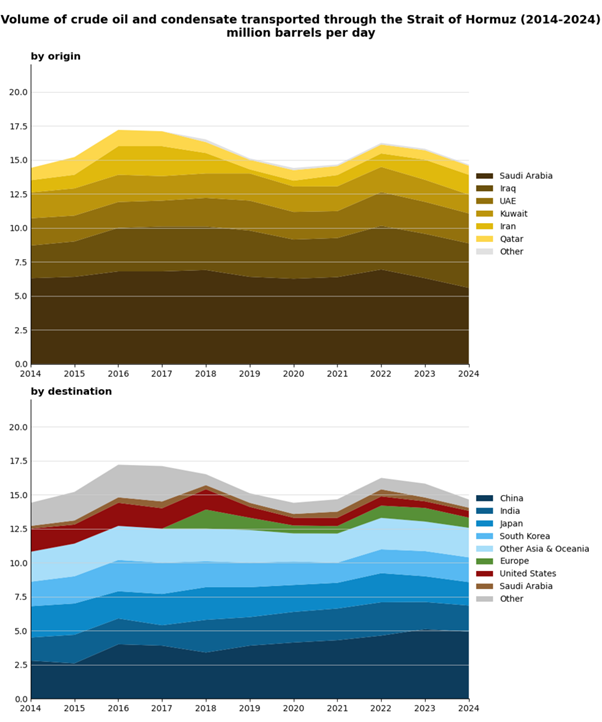
The above diagram shows the declining importance of Europe and the US as destinations for hydrocarbon exports from the Persian Gulf. Asia has stepped up as the big destination for such exports, and this is a good reason for India to make clear its opposition to the closure of the Strait.
But there are other effects, on both export of other essential commodities, and imports for Iran that also deserve attention. Two very important commodities which were exported were Sulphur and Helium. Both are by-products of oil or gas refining: Sulphur is produced in the process of refining crude oil, and is used for manufacturing fertilisers, thus threatening agriculture. The sulphur is also used for making sulphuric acid, which is needed for extracting copper and cobalt from ores. The Guardian reports that repairing the damage to Qatari facilities alone will demand thirty thousand kilogrammes[21].
A second vital element is helium, of which Qatar was a major producer, since it is a by-product of extracting natural gas by cryogenic distillation, and Qatar shares the world’s largest natural gas field with Iran in the Persian Gulf. The Iranian attack on the Ras Laffan facility ended the production of natural gas, and hence of helium. This gas is used in the cooling of silicon wafers in the process of printing transistors on the wafers; helium is one of the most effective coolants in the world. Again, the loss of Qatar’s capacity is hitting the global markets, as the withdrawal from the market adds up to some 10%, although the situation is still under control, as there are containers of helium still available for shipping to the world market. But if the disruption is prolonged, it will affect chip-making, especially in South Korea, which was heavily dependent on Qatari supplies.
There is, finally, the question of Iran’s own exports and imports. Following Iran’s closure of the Strait by the IRGC [the Foreign Office insisted it was open, and was snubbed by the IRGC], the US imposed its own blockade of Iranian ports, thus preventing any ships loading or unloading at Iranian ports from transiting the Gulf of Oman. Iran’s only means of exporting oil, at present, is by sea, and ninety percent of its exports go to the PRC. President Xi is reported to have told President Trump at their summit meeting in mid-May that they intend to continue purchasing Iranian oil, and President Trump confirmed that he had “allowed” some ships to go through.
All the same, the blockade is hurting, and some estimates put Iran’s revenue loss at $400 million per day. But one should approach assessments of the effectiveness of blockades with some caution: Qatar was blockaded for several years by its Arab neighbours from 2017 to 2021, to little effect.
As for Iran’s imports, there is little by way of reliable data, but there are likely to be some problems, especially in terms of foodgrains, which are the largest item in Iran’s import basket. There is an effort on the part of Iran to find alternative routes, including overland connections and through the Caspian Sea. Depending on how far Russia and the PRC are willing to aid Iran, these could take care of both import and export needs.
The oil trade, in particular, could continue through a swap mechanism, with Iran supplying to Russia through Turkmenistan, and Russia increasing corresponding sales to the PRC.
Iran has now set up a new body to manage the Strait, named the “Persian Gulf Strait Authority” in order to “exercise sovereignty” over the Strait and to offer real-time information on operations in the Strait[22]. Details are said to follow, presumably regarding tolls and other regulations.
The demand for sovereignty and the right to levy charges over the Strait is unusual: except for the Black Sea Straits, no other natural waterway is considered any country’s sovereign right. In the case of the Black Sea, there is some logic, however weak, that Turkey straddles both sides of the Straits; and there is history to it too, the aim being to block Russian access to the open seas. Otherwise, tolls are applied only in human-made waterways, where labour and capital were spent, and need to be recouped, as in the Suez or Panama Canals.
Foreign Countries’ Interests and Roles
India
India’s economic interests are well-known and do not bear repetition. But there are some aspects that are not talked about much, and they are important for setting the right perspective on developments in the region. Over the past few years, Iran’s proxies like Hamas have been engaging with Pakistan-based terror groups like L-e-T and J-e-M. In fact, there was a meeting of all of these groups in POK in early 2025, and there was also a representative from Iran present. This represents a serious security threat to India.
In addition, the late Ayatollah Khamenei had occasionally made some hostile remarks against India and Hindus. In 2017, he called the Muslim world to support “the oppressed Muslims of Kashmir”; after the amendment of Art 370 and removal of 35A, he wrote on X: “we’re concerned about Muslims’ situation in Kashmir…we expect the Indian government to adopt a just policy towards the noble people of Kashmir and prevent the oppression and bullying of Muslims in this region”. In March, during the violence in Delhi, he said, “the hearts of Muslims all over the world are grieving over the massacre of Muslims in India – the government of India should confront extremist Hindus and their parties and stop the massacre of Muslims in order to prevent the isolation of India from the world of Islam”.
As for Indian-interest shipping through the Strait of Hormuz, after an initial period of relative ease, there were troubles later on, including instances of firing on Indian ships, despite their having taken prior clearance. More recently, an Indian ship has been sunk in the Gulf of Oman, even though it is not clear who was responsible for the attack. The Indian Government has condemned the attack, without holding anyone responsible.
A cause for concern in India, not necessarily related to the war itself, is the weakness of the Indian Rupee. It has fallen sharply in recent weeks and is touching Rs 96 to the US Dollar. The steady depreciation is a negative for foreign investors, who find their Dollar earnings facing a built-in loss of 5% or so as the Rupee keeps falling. Other currencies have not fallen either so far, or so fast – even the Iranian Rial has held steady at 1.4 million to the Dollar since the war began.
Arab Neighbours
Most of the Persian Gulf Arab neighbours have been overtly neutral, though there have been reports in the media and social media that they have been asking the US to “cut off the head of the snake”. Iran has been attacking their economic, mainly oil, installations and their military bases, many of which host US military assets. This has even been criticized by Hamas. But the most telling case has been the UNSC vote condemning Iran’s attacks on the Arab countries, as described above. An indication of the unpopularity of Iran is the fact that the Bahrain-sponsored resolution to this effect got 135 co-sponsors – the record for co-sponsorship in UN history.
Iran has even attacked Oman and Qatar, two countries that have been supportive of Iran.
One aspect worth noting is the estrangement between the Saudis and the Emiratis in recent months. It began with friction over Yemen but has expanded since then. The UAE has also been the top target of Iranian attacks and has responded by cutting down Iranian financial channels, which relied on Dubai for its transactions around the world. This, coupled with the US blockade, could cripple Iran’s functioning in a big way.

The UAE is also planning to step up the capacity of its currently functioning oil pipeline along the coast to Fujairah, thus bypassing the Strait of Hormuz chokepoint. The current pipeline originates at Habshan, the hub of Abu Dhabi’s oil fields, and runs 360 km to Fujairah; it has a capacity of carrying 1.5 million barrels per day, or some 36 percent of the UAE's total exports. The UAE has now exited OPEC, and plans to break out of the discipline, and export up to 5 mbd once the pipelines are fully functional – the planned date is end-2027[23].
The UAE also has a long-running dispute with Iran over the Persian Gulf islands – Abu Musa, and the Greater and Lesser Tunbs – which Iran occupied in late 1971, after the British withdrawal east of Suez. More on this below, in the PRC section.
Saudi Arabia is planning a similar expansion of its East-West pipeline to Yanbo, from its current capacity of some 7 mbd, although this amount would cover all of Saudi Arabia's current level of exports. This would explain why Iran has lately chosen to attack both Fujairah and Yanbo.
Russia
Russia was the primary security and economic partner for Iran, but has been incapacitated by its own debilitating and increasingly fruitless, war in Ukraine. Russia has offered to take over Iran’s 440 kg of HEU as a solution to the problem of what to do with the uranium. However, Iran is unwilling to agree to this. There are also suspicions that Russia has supplied some arms to Iran through the Caspian Sea, though both sides deny this. But there was a recent episode where the Israeli forces did attack some targets in the Caspian Sea.
What does seem likely is that Russia has helped Iran with intelligence and has collaborated on improving drone technology: as a result, Iran has scored some effective hits on the US carrier Abraham Lincoln, which was forced to retreat to Croatia for repairs, as well as on some destroyers. The targeting of US bases in the region also owes to collaboration between Russia and Iran.
Similarly, the closure of the Strait of Hormuz has benefited Russia by pushing up oil prices and providing the country with much-needed financial relief. And as prices rose past the $100-mark for Brent crude, President Trump was forced to lift the embargo on Russian oil exports – this also benefited India.
At the same time, it is worth noting that Russia, like the PRC, has allowed a number of UNSC Resolutions to be adopted, which are very critical of Iran.
PRC
The US has accused the PRC of aiding Iran with intelligence and arms, charges that it denies. The only time it has shown its hand is recently when President Xi phoned the Saudi crown prince and expressed himself against any blockade of the Strait of Hormuz. He probably intended it to be seen as opposition to the US blockade, because he said nothing when Iran was restricting ship movements through the Strait. The reason is not far to seek: Iran exports about 90% of its total exports to the PRC. Nevertheless, it is noteworthy that President Xi chose to approach the Saudis publicly on this issue, and not either Iran, or the US, or issue a general statement.
PRC was then also preparing for a visit by President Trump in mid-May, and that may also explain the low-key stance of the PRC. But it is a safe presumption that Iran would be disappointed by this stance, just as with Russia.
One should add a caveat, though: President Xi has consistently shown a mild proclivity towards supporting the Arab position in the Gulf. There was a prominent episode when President Xi visited Saudi Arabia in December 2022, and expressed support for the UAE position on the three Persian Gulf islands, Abu Musa, and the Greater and Lesser Tunbs, and had also implicitly opposed Iran’s nuclear programme[24]. Iran had responded by summoning the PRC Ambassador and expressing its unhappiness over the incident. The PRC sent a Politburo member to Tehran to calm things down; later, Foreign Minister Wang Yi patched things up between the Iranians and the Saudis.
Judging from the limited substantive information that has emerged from the Trump-Xi summit, it would appear that the latter did not carry much water for Iran.
Pakistan
Pakistan’s active role has been in the headlines over the past few weeks, as the PM and the field marshal have shuttled between capitals in the search for a settlement. The second round of US-Iran talks was due to happen, but the Iranians declined to send another delegation, and President Trump similarly forbade his delegation – now minus Vance – from going to Pakistan. Indirect messaging is still going on, but their stated positions are still unbridgeable. But there is a limit to the military capacity of all sides, both offensive and defensive. In addition, Iran cannot afford more than a few weeks of the blockade, as it will run out of storage capacity for the unexported oil.
Pakistan has played both sides in the recent past: it opposed the snap-back last September, but it supported the Bahrain-sponsored UNSC resolution condemning Iran for bombing the Arab countries. It has been doing that for decades, and at least one influential Senator, Lindsey Graham has apparently had enough. At a recent hearing with the War Secretary, he denounced Pakistan’s role, saying he would not trust the country as far as he could throw it[25].
“No wonder this damn thing is going nowhere,” he added.
Obiter Dicta
[i] The current fighting needs to be seen in the context of the vaunted new world order: defeats – and victories – have consequences, and a defeat of the US, however defined and perceived, will affect the global power balance. Over the last hundred years, starting with the defeat of the Russian, German, and Turkish Empires, their system, and their geography. Later, the defeat of the US in Vietnam encouraged the USSR to expand into the developing world, until its fatal mistake in Afghanistan. That defeat caused the collapse of the USSR. The US’s own defeat in Afghanistan, and the pell-mell retreat, has led to questions about the American staying power. If they fail in Iran, that would have serious consequences for its place in the world.
[ii] The nature of warfare is changing; while in the past, defence and offence were more or less equally poised, with variations required in numbers, today, defensive operations have become cheaper, and harder to overcome. This may be seen in Ukraine and in Iran – contactless fighting, and the use of drones have made defence more privileged in operations.
[iii] Three very strong-willed combatants are involved in the current fighting. The winner will be the side that can survive the pain each is inflicting on the other. For both Israel and Iran, specially for the latter, survival is at stake. This is why they are ready to fight to the finish – and the US alone has the luxury of not having any such doubts. But if it cannot wrap up Iran’s nuclear programme, its standing will be negatively affected.
[iv] There are internal divisions in both Iran and the US over the approach to be taken towards the war. In Iran, the IRGC is essentially in charge, and seems determined to fight on as long as required; the “civilian” side is more open to negotiations, but within tight parameters, which rule out any nuclear compromise. Thus, if there is to be any change in Iran’s stance, that may require a regime change. In the US, the differences are neither so sharp, nor is there any doubt that President Trump can do what he decides, at least until the mid-term elections this November. Israel, on the whole, is more united.
[v] The Indian policy options are difficult, as they invariably are, when two close partners clash. Israel is a friend – a rare thing in international affairs – that has stood with us in times of need. It has also supplied some sensitive technologies that we need. Iran is our access to Eurasia, and possibly energy at some future date. The Indian government has done well so far to avoid making a choice, but could take a clearer stand on the Strait of Hormuz, whose closure by Iran – not the US – is hurting our economy. As for Iran’s nuclear programme, it should be clear that a nuclear Iran poses no direct threat to India – our threat is full up with Pakistan and the PRC. But a nuclear Iran does pose risks to the Arabs and Israel, as well as to the non-proliferation regime.
May 2026,
Camp: Zurich.
References
[2] https://www.wsj.com/opinion/hamas-sexual-violence-report-civil-commission-october-7-israel-2e68d781?mod=opinion_lead_pos1
[3] https://www.stimson.org/2023/why-are-the-houthis-getting-involved-in-a-war-between-israel-and-hamas/
[7] H.R.1191 - 114th Congress (2015-2016): Iran Nuclear Agreement Review Act of 2015 | Congress.gov | Library of Congress
[11] Analysis of IAEA Iran Verification and Monitoring Report — May 2025 | ISIS Reports | Institute For Science And International Security
[13] gov2025-38.pdf – for full text of Board of Governors statement
[16] Peace ‘within reach’ as Iran agrees no nuclear material stockpile: Oman FM | Military News | Al Jazeera
[19] Bill Clinton: Young Americans shocked to learn Arafat turned down Palestinian state | The Times of Israel
[21] West Point analysis warns that strait of Hormuz blockade will strangle US defense industry | US-Israel war on Iran | The Guardian
[22] https://www.france24.com/en/middle-east/20260518-iran-announces-new-body-to-manage-strait-of-hormuz-as-peace-talks-stall
[24] https://www.spa.gov.sa/2408192 - see paragraphs 9 and 12.
(Ambassador Prabhat Prakash Shukla (retd.) is the former Ambassador of India to Russia. He is currently on the Board of Advisors of Global Order.)


Có dễ dùng không? https://hi88cz.com/ mình vào thử thì thấy ổn, kiểu nhìn cái là biết nên bắt đầu từ đâu luôn. Mình không có thời gian đọc kỹ hay lục lọi gì, chỉ đảo qua vài trang cho biết, nhưng cách họ đặt menu khá lộ nên chuyển qua lại nhanh, không phải kéo tới kéo lui mới thấy. Nội dung thì chia thành từng khối/ô rõ ràng, nhìn một đoạn là phân biệt được phần nào đang nói về gì, chữ cũng tách dòng ổn nên đọc không bị dính mắt, cảm giác gọn gàng chứ không rối. Nói chung giao diện làm theo kiểu thực dụng, ai mới vào cũng nắm nhịp được nhanh. Mình thích nhất…
Nếu có kế hoạch săn mây, ghé Biển Hồ hay đơn giản là đi cà phê quanh Pleiku, mình nghĩ nên xem dự báo trước. Website Thời tiết Gia Lai cho khá nhiều thông tin thực tế như cảm giác nhiệt độ, sức gió, tầm nhìn, UV, bình minh và hoàng hôn. Mình còn có thể xem thời tiết riêng ở các phường, xã nên việc chuẩn bị lịch trình thuận tiện hơn.
Many green-living sites focus on efficiency charts and carbon math, but this one seems to keep comfort in the picture. The cozier eco home tips angle is what sets it apart.
uu88sh com mình vừa mở lên nghịch thử cho biết trong lúc rảnh, nói thật là mình hơi dè chừng vì mấy trang kiểu này đôi khi bày biện lung tung, nhưng lướt qua thì thấy họ chia khối nội dung khá gọn, nhìn một cái là biết phần nào là chính với phần nào chỉ là thông tin kèm theo nên đỡ phải dò. Mình không đọc kỹ hết, chỉ liếc vài chỗ xem có rõ ràng không. Có mục PHÁ GẠCH, tên nghe đơn giản nên mình bấm vào xem thử. Hướng dẫn điều khiển ghi ngay trong nội dung, kiểu ← → hoặc A D để di chuyển thanh, Space để bắt đầu bắn. Vậy là đủ…
Mình hay ưu tiên các bài viết nói về game giải trí theo kiểu tóm tắt, dễ đọc trên điện thoại. Phần nói về trang chủ Sc88 bù link nha được đặt ở giữa nội dung nên mạch bài khá tự nhiên, không bị “đẩy” ngay từ đầu. Bài mô tả nền tảng theo hướng gọn gàng, thao tác nhanh và có nhiều nhóm trò chơi để lựa chọn như slot, mini game, esport, thể thao... Cách viết vừa đủ thông tin để người đọc tự hình dung trải nghiệm.